Wiki article
Assessing Colony Food Reserves
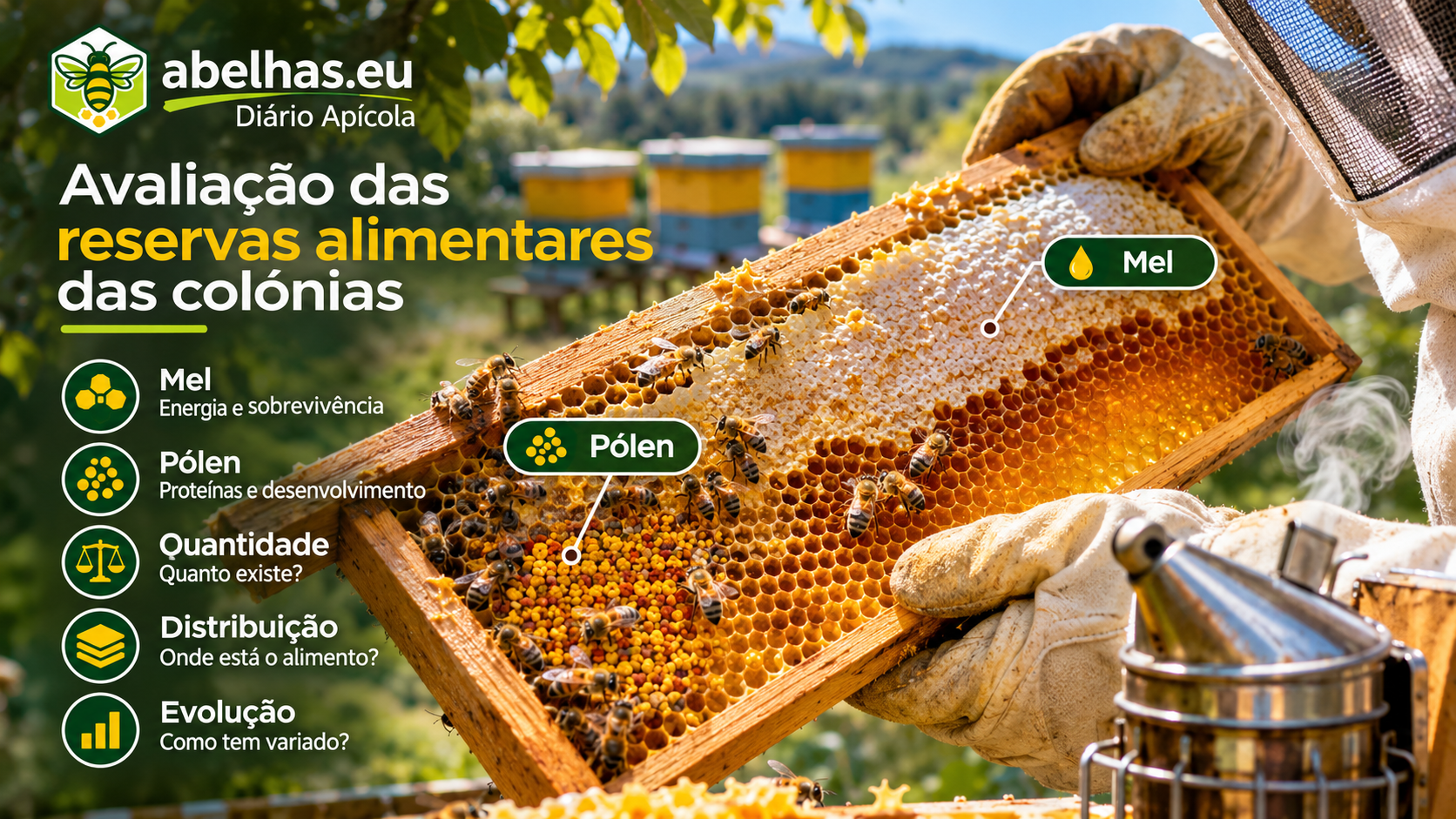
Food availability is one of the fundamental factors for the development and survival of a honey bee colony.
By Equipa abelhas.eu
Article
Throughout the year, food needs vary depending on the population, the amount of brood, weather conditions, and the availability of floral resources.
A colony may have a large and apparently healthy population but be in a vulnerable situation if food reserves are insufficient for its needs.
Similarly, the presence of stored honey does not necessarily mean the colony has enough food or that it is accessible under all circumstances.
Assessing food reserves is not just about verifying the presence of honey and pollen. It is necessary to understand the quantity, distribution, and evolution of these resources.
1. What Food Does a Colony Need?
Bees depend on different nutrients to ensure their individual and collective functions.
The main food resources collected by honey bees are nectar and pollen.
Nectar and Honey
Nectar is an important source of carbohydrates. After collection, it can be consumed by the bees or transformed and stored as honey.
Carbohydrates provide energy for activities such as:
- Flight and resource collection.
- Maintenance of colony activities.
- Heat production.
- Feeding and metabolism of adult bees.
- Wax production.
Honey reserves allow the colony to maintain its activity during periods when nectar intake is insufficient.
Pollen
Pollen provides proteins, lipids, vitamins, minerals, and other essential nutrients.
It is particularly important for:
- Larval development.
- Nutrition of young bees.
- Development of glands responsible for larval food production.
- Maintenance of bees' physiological functions.
The amount of available pollen is not the only relevant factor. Its diversity and nutritional quality also influence the colony’s nutrition.
A colony may have adequate energy reserves and simultaneously face nutritional limitations due to pollen scarcity or insufficient quality.
Water
Water is also essential to the colony.
It is used, among other functions, in regulating the hive’s internal conditions and preparing food.
Although it is not typically considered a stored reserve in the same way as honey or pollen, water availability should be considered when assessing the apiary’s food and environmental conditions.
2. How to Identify Existing Reserves
The assessment can be carried out through comb observation, hive weight estimation, and analysis of the colony’s history.
Each method provides different information.
2.1. Comb Observation
During an inspection, it is possible to identify areas with stored honey, nectar, and pollen.
In brood frames, it is common to find food reserves in the areas surrounding the brood, although distribution varies between colonies and hive systems.
The observation should consider:
- Approximate number of combs occupied by honey.
- Presence of capped and uncapped honey.
- Distribution of reserves inside the hive.
- Presence of stored pollen.
- Relationship between the amount of food and the existing population.
The presence of capped honey cells may indicate stored food, but their quantity should be assessed along with the remaining reserves.
A frame with honey does not necessarily correspond to a fixed amount of food.
The quantity depends on the frame’s dimensions, the area actually filled, and the content of the cells.
2.2. Weight Estimation
The hive’s weight can provide complementary information about the evolution of reserves.
There are different ways to monitor this variable:
- Partially lifting the hive for an approximate assessment.
- Using portable scales.
- Periodic weighing of the hive.
- Continuous monitoring through weight sensors.
Weighing allows identifying variations over time but does not automatically distinguish the weight of food from the weight of bees, brood, water, or equipment components.
For example, a weight increase during a flowering period may be related to nectar intake but can also be influenced by other changes.
Similarly, a weight reduction may result from reserve consumption or other factors associated with the colony’s dynamics.
2.3. Comparison with Previous Observations
The evolution of reserves is often more informative than an isolated observation.
A colony with moderate reserves but rapidly consuming food may require more attention than another with similar reserves and reduced consumption.
Therefore, it is important to record not only the estimated quantity but also its evolution.
Frame or Bar Assessment
A practical approach involves estimating the proportion of each frame or comb occupied by honey.
For example:
| Frame | Approximate Area with Honey |
|---|---|
| 1 | 100% |
| 2 | 75% |
| 3 | 50% |
| 4 | 25% |
In this example, the sum of the areas corresponds to approximately 2.5 frames fully filled with honey.
This value does not directly represent a quantity in kilograms.
To convert the estimated area into weight, it would be necessary to know the approximate storage capacity of the frames used and consider the characteristics of the combs.
The estimate should be interpreted as an approximation, not as an exact measurement.
Weight Assessment
When a scale is available, the total weight of the hive can be monitored over time.
To estimate the amount of food, it would be necessary to consider the weight of the hive components and other variable elements.
A simplified way to represent this relationship is:
Total weight = equipment + bees + brood + reserves + other components
In practice, not all of these components are known with precision.
For this reason, weighing is especially useful for tracking trends, even when it does not allow determining the exact amount of food available.
4. How Much Food Should a Colony Have?
There is no universal amount of food suitable for all colonies.
Needs depend on several factors:
- Population size.
- Amount of brood.
- Time of year.
- Weather conditions.
- Availability of nectar and pollen.
- Hive type.
- Expected duration of scarcity periods.
- Regional characteristics.
A populous colony may consume more food than a small colony, especially when maintaining a significant amount of brood.
However, the relationship between population and consumption is not necessarily linear, as activity, temperature, and colony organization also influence energy needs.
The Importance of Regional Context
In Portugal, the availability of floral resources shows significant differences between regions and throughout the year.
In some areas, certain blooms may provide nectar and pollen during periods when other regions experience scarcity.
Weather conditions also influence the bees' ability to utilize these resources.
An abundant bloom does not guarantee food intake if flight conditions are unfavorable.
Therefore, assessing reserves should consider both the floral calendar and the actual conditions observed in the apiary.
5. Reserve Distribution Also Matters
The total amount of food is not the only element to consider.
The location of reserves inside the hive can influence their accessibility.
During periods of low temperatures, bees may form a tight cluster to conserve heat.
Under these conditions, the cluster’s movement to reach food may be limited.
A colony may, under certain circumstances, have reserves in one area of the hive and struggle to use them.
Reserve organization should be interpreted considering:
- Population location.
- Presence and distribution of brood.
- Position of combs with food.
- External temperature.
- Internal hive configuration.
This question is particularly relevant during prolonged cold periods.
6. Identifying Signs of Food Insufficiency
Food insufficiency can manifest through various changes.
Among the signs that warrant attention are:
- Sharp reduction in observed reserves.
- Persistent decrease in hive weight.
- Pollen scarcity during brood-rearing periods.
- Changes in brood development.
- Progressive weakening of the population.
- Mortality associated with other signs of food scarcity.
None of these indicators alone can confirm a situation of nutritional deficiency.
For example, a reduction in brood may result from the time of year, changes in the queen, health factors, or food limitations.
Interpretation should combine multiple indicators and consider the colony’s history.
Energy Scarcity and Protein Scarcity
It is important to distinguish between two situations.
Insufficient energy reserves can quickly compromise the colony’s survival, especially when environmental conditions limit food collection.
Insufficient protein resources can affect brood development and the physiological condition of bees, even when honey reserves exist.
These situations can occur separately or simultaneously.
7. Supplemental Feeding: When to Consider?
Supplemental feeding may be used when the colony’s conditions and the availability of natural resources justify it.
The decision should consider:
- Quantity and quality of existing reserves.
- Needs of the population.
- Presence of brood.
- Weather conditions.
- Expected availability of natural resources.
- Purpose of the intervention.
- Colony’s health conditions.
There are different types of supplemental feeding, including energy foods and supplements designed to support protein nutrition.
The suitability of each solution depends on the circumstances.
Energy Feeding
Appropriate foods can be used to provide carbohydrates when energy reserves are insufficient.
The form of presentation should consider environmental conditions and the bees' ability to use the food.
During cold periods, the use of liquid foods may present limitations, depending on the temperature and the colony’s conditions.
Protein Feeding
Protein supplementation may be considered in specific situations of pollen scarcity or increased nutritional needs.
However, its use should take into account the food’s composition, the colony’s consumption capacity, and the intended goals.
Supplements do not necessarily replicate all the nutritional characteristics of diverse natural pollen.
Important Considerations
Supplemental feeding requires attention to good beekeeping practices.
Foods of unknown origin or unsuitable should be avoided, especially when they may pose health risks.
Using honey of unknown origin to feed colonies can introduce pathogens.
It is also important to prevent situations of robbing, contamination, or fermentation of the provided foods.
When producing honey for human consumption, applicable rules must be followed to avoid adulteration or contamination of the product.
Supplemental feeding should address an identified need, not replace the assessment of the colony’s conditions.
8. Monitoring Reserves Throughout the Year
Food needs and resource availability vary seasonally.
Spring
The increase in brood and population can significantly raise nutritional needs.
Even during flowering periods, unfavorable weather conditions can temporarily limit food intake.
Summer
Resource availability depends on the region and existing blooms.
In certain areas, periods of intense heat and drought can cause nectar and pollen scarcity.
Fall
Assessing reserves becomes especially important as a prolonged period of reduced resource availability approaches.
The nutritional status of bees produced during this phase can influence the colony’s ability to survive the winter.
Winter
Consumption depends on weather conditions, population, and the amount of brood maintained.
In milder regions, continued activity and brood rearing can maintain significant food needs.
Observing reserves should be balanced with the need to avoid unnecessary disturbances during cold periods.
9. What to Record in Each Assessment
A simple and consistent record allows tracking the evolution of reserves.
| Information | Example |
|---|---|
| Date | 11/07/2026 |
| Apiary | Apiary A |
| Hive | Hive 12 |
| Population | 7 occupied frames |
| Honey | Moderate reserves |
| Pollen | Present in 2 frames |
| Brood | Reduced |
| Weight | 28.5 kg |
| Food intake | Reduced |
| Supplemental feeding | Not performed |
| Observations | Reassess reserve evolution |
The weight shown is merely illustrative and does not correspond to a recommended amount of reserves.
To improve consistency, the beekeeper can use self-defined assessment scales.
For example:
| Classification | General Criterion |
|---|---|
| Very low | Residual reserves |
| Low | Reduced reserves relative to estimated needs |
| Moderate | Reserves present, requiring monitoring |
| High | Abundant reserves relative to estimated needs |
These classifications are relative and should be applied consistently.
Comparison becomes more useful when the criteria used are similar between inspections.
10. Interpreting Trends
Consider a colony with the following history:
| Indicator | Visit 1 | Visit 2 | Visit 3 |
|---|---|---|---|
| Population | 8 frames | 8 frames | 7 frames |
| Honey reserves | High | Moderate | Low |
| Pollen | Abundant | Moderate | Scarce |
| Brood | Abundant | Moderate | Reduced |
The simultaneous decrease in reserves and brood may justify a more in-depth assessment.
However, these data alone do not demonstrate a causal relationship.
The change may be related to resource availability, seasonality, queen condition, or other factors.
The analysis should also consider weather conditions, the floral calendar, and the colony’s health status.
Observation shows the colony’s condition. Comparing records helps understand its evolution.
11. How abelhas.eu Can Help
abelhas.eu allows recording observations made during inspections and associating them with the respective hives and apiaries.
Maintaining a history facilitates comparison between different times and allows relating the evolution of reserves with other aspects of the operation.
The beekeeper can review previous observations, interventions performed, and information available in reports.
The calendar helps organize monitoring activities, while cost records assist in maintaining information about expenses associated with supplemental feeding.
Augusto, the digital assistant of abelhas.eu, can help review and interpret the recorded information, identifying changes or trends that may require attention.
The usefulness of these analyses depends on the quality and consistency of the available data.
The decision regarding feeding and management always remains in the hands of the beekeeper.
Conclusion
Assessing food reserves is an essential activity for understanding the development and survival conditions of colonies.
The amount of honey and pollen available should be considered along with the population, brood, environmental conditions, and availability of natural resources.
Food distribution and accessibility can also influence the colony’s ability to use existing reserves.
There is no universal amount of food suitable for all situations.
Assessing, recording, and monitoring the evolution of reserves allows identifying needs and supporting management decisions, respecting the characteristics of each colony and each apiary.
Did You Know...?
A colony may have seemingly sufficient honey reserves and still face nutritional difficulties due to pollen scarcity.
Honey primarily provides energy, while pollen contributes proteins and other essential nutrients for bee development.
Therefore, assessing only the amount of honey does not fully reveal a colony’s food situation.
References
- Direção-Geral de Alimentação e Veterinária (DGAV) — Apiculture and Animal Health.
- Food and Agriculture Organization of the United Nations (FAO) — Apiculture and Technical Resources.
- COLOSS — Research on Colony Health and Losses.
- Brodschneider, R. & Crailsheim, K. (2010). Nutrition and health in honey bees. Apidologie, 41, 278–294.
- Winston, M. L. (1987). The Biology of the Honey Bee. Harvard University Press.
- Seeley, T. D. (1985). Honeybee Ecology: A Study of Adaptation in Social Life. Princeton University Press.
This article is for informational purposes only and does not replace technical or veterinary assessment. Management decisions should consider the operation’s conditions, applicable legislation, and recommendations from competent authorities.
Related articles
- Cork Oak — *Quercus suber*
The cork oak (*Quercus suber* L.) is one of the most emblematic trees in the Portuguese landscape. Primarily known for its cork production, it also plays a significant role in Mediterranean ecosystems, contributing to biodiversity, soil protection, and the maintenance of habitats favorable to numerous insect species.
- Preparing Colonies for Winter
Winter’s arrival represents a major change in honey bee colony activity. Lower temperatures, fewer daylight hours, and reduced floral resources influence bee behavior and brood development.