Wiki article
Splitting Colonies and Forming Nuclei
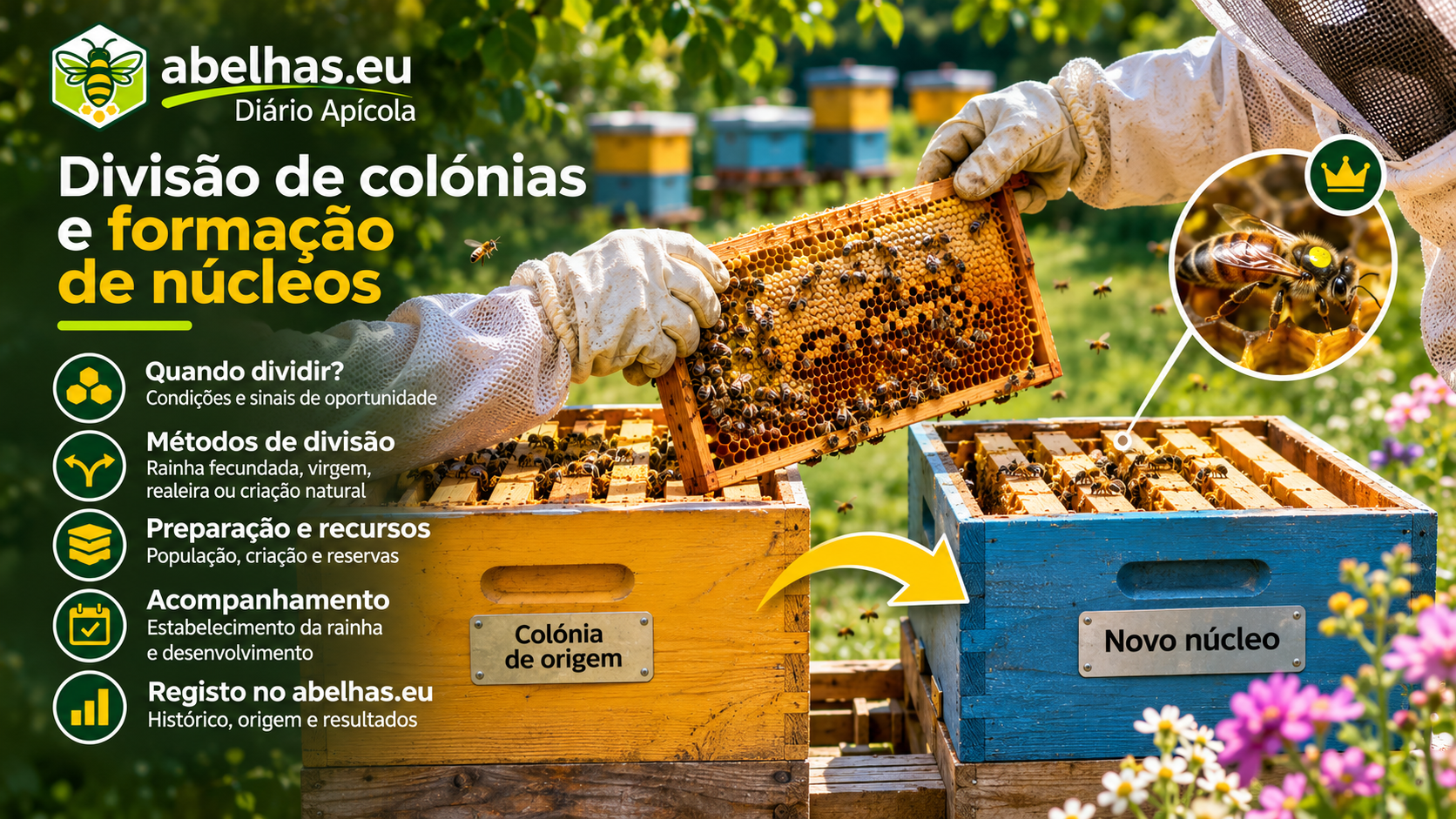
Splitting colonies is a beekeeping management practice that increases the number of colonies in an operation, replaces or renews stock, and, under certain circumstances, manages the population of highly developed colonies.
By Equipa abelhas.eu
Article
Though a relatively common operation, splitting a colony is not just about distributing bees and frames between two boxes. Success depends on available population, existing brood, food stores, environmental conditions, and, most importantly, each new unit’s ability to establish a functional queen.
There are different ways to perform a split. No single method is universally suitable: the choice depends on the beekeeper’s goals, colony conditions, and available resources.
1. What Is a Nucleus?
A nucleus is a small colony consisting of a bee population, brood, and food stores, housed in an appropriate box or hive compartment.
It can be formed for several purposes:
- Increasing the number of colonies in an operation.
- Replacing lost or weakened colonies.
- Preparing colonies for sale or transfer.
- Introducing and evaluating new queens.
- Supporting selection and breeding programs.
- Managing the development of strong colonies.
A newly formed nucleus does not necessarily have immediate autonomy. It needs enough bees to maintain brood temperature, feed larvae, defend the entrance, and sustain development until new workers emerge.
Forming a nucleus should therefore be seen as the start of an establishment process, not an operation completed at the moment of splitting.
2. When to Split a Colony?
The most favorable period generally coincides with a phase of colony development, natural resource availability, and weather conditions that allow new units to grow.
In Portugal, spring is often the most suitable time, though the timing can vary significantly between regions and years.
Along the coast, inland, in mountainous areas, or regions with different blooming cycles, favorable conditions may occur at distinct times.
Before splitting, it is important to assess:
Population: Does the source colony have enough bees to support the split without compromising its development?
Brood: Are there frames with capped brood and, when necessary, eggs or young larvae?
Stores: Does the colony have sufficient honey and pollen to feed the new units?
Health: Are there signs of disease, high Varroa infestation, or other health issues?
Weather conditions: Do temperatures allow brood to stay warm and, when necessary, enable mating flights?
Drone availability: If the nucleus must produce and mate a queen, are mature drones present in the area?
A split performed too early, with insufficient resources, or from a weakened colony can compromise both the nucleus and the source colony.
3. Preparing the Split
Before starting, define the goal and method for forming the nucleus.
Preparation includes:
- Selecting a healthy and sufficiently developed source colony.
- Verifying the queen’s presence and, if necessary, her location.
- Identifying brood and food reserve frames.
- Preparing a box or nucleus suitable for the number of frames.
- Ensuring proper ventilation, protection, and space proportional to the population.
- Determining how the new nucleus will acquire a queen.
- Preparing a follow-up plan for the following weeks.
The proportion of frames and bees to transfer depends on hive format, colony strength, season, and method used.
More important than following a fixed number of frames is ensuring the nucleus has enough resources to sustain and develop itself.
4. Main Methods for Forming Nuclei
4.1. Split with a Mated Queen
In this method, the new nucleus receives a mated queen from the beekeeper’s own operation or purchased from a breeder.
The main advantage is reducing the time needed to establish a laying queen, provided the introduction is successful.
Generally, the process involves:
- Selecting the frames and bees that will form the nucleus.
- Ensuring the source colony’s queen is not inadvertently transferred.
- Installing the nucleus in the prepared box.
- Observing an appropriate queenless period for the chosen introduction method.
- Introducing the new queen using a proper procedure, often with a cage.
- Later confirming acceptance and egg-laying.
Introducing a queen does not guarantee acceptance. Worker behavior, queen cell presence, queenless period length, and colony conditions can influence the outcome.
Verification should be done in a way that avoids unnecessary disruption.
4.2. Split with a Virgin Queen
The nucleus receives a virgin queen that must complete mating flights before beginning to lay.
This method requires suitable conditions for mating, including favorable temperatures, mature drones, and flight opportunities.
The time until egg-laying begins is variable.
The absence of eggs in the first few days does not necessarily mean the introduction failed. However, a prolonged period without egg-laying requires evaluation, as the queen may not have been accepted, may have been lost during flights, or may be experiencing mating difficulties.
During this phase, it is especially important to avoid excessive inspections that could disturb the queen.
4.3. Split with Natural Queen Rearing
In this method, the nucleus is formed without a queen but receives eggs or sufficiently young larvae so workers can rear a new queen.
The colony begins constructing emergency queen cells, feeding selected larvae to develop future queens.
The process involves several steps:
- Forming the nucleus and leaving it queenless.
- Workers selecting suitable larvae.
- Queen cell development and capping.
- Virgin queen emergence.
- Maturation and mating flights.
- Start of egg-laying, if mating is successful.
Developing a queen from an egg to emergence takes approximately 16 days. However, in a nucleus formed with existing larvae, the remaining time until emergence depends on their age.
Egg-laying begins later and varies with environmental conditions and mating success.
This method avoids the need to purchase a queen but involves a longer period without new worker brood and greater exposure to risks associated with rearing and mating.
4.4. Split with a Queen Cell
Another option is transferring a viable queen cell to the nucleus, sourced from a queen-rearing process or a selected colony.
Using a queen cell can reduce the time until the queen emerges compared to rearing from eggs or young larvae.
Whenever possible, it is essential to know the queen cell’s age and condition.
Queen cells are delicate structures, especially at certain developmental stages, so handling and transport should be done carefully.
After emergence, risks associated with mating and establishing egg-laying remain.
5. Distributing Bees and Frames
One of the most important decisions is determining the nucleus’s initial composition.
Adult Bees
The nucleus needs workers to warm brood, feed larvae, process food, and defend the entrance.
It is important to consider that forager bees may return to the source hive when the split is performed in the same apiary.
As a result, a nucleus that appears well-populated during formation may lose part of its population in the following hours.
The beekeeper can manage this effect through location, population composition, and proper orientation techniques.
Capped Brood
Capped brood allows new workers to emerge in the following days, helping renew and strengthen the nucleus’s population.
However, it also requires thermoregulation capacity until emergence.
Open Brood
Open brood requires continuous feeding and care.
If the nucleus is to produce a queen, it is essential to ensure the presence of eggs or sufficiently young larvae.
When an external queen is introduced, brood composition should be considered based on the introduction method.
Food Stores
The nucleus must have adequate energy and protein resources for its population and existing brood.
Stores should be assessed alongside regional nectar and pollen availability.
In times of scarcity, supplemental feeding may be necessary, following good health and food safety practices.
6. What Happens to the Source Colony?
Splitting affects both the new nucleus and the colony from which resources were taken.
Transferring bees and brood may temporarily reduce:
- Adult population.
- Nectar and pollen collection capacity.
- Developing brood quantity.
- Honey production potential.
- Colony growth capacity.
The intensity of these effects depends on the split’s size, the colony’s initial strength, and recovery conditions.
A strong colony can recover quickly under favorable conditions. A less developed colony may need more time or become vulnerable to additional issues.
Therefore, monitoring should always include both units.
7. Monitoring the Nucleus After Splitting
Forming the nucleus is just the first step.
In the following weeks, it is important to monitor development without causing excessive disruption.
First Days
Check, as needed, if the nucleus maintains sufficient population, has food, and has proper ventilation and defense conditions.
If a queen was introduced, monitor her acceptance according to the chosen procedure.
Queen Establishment
Confirm the presence of a functional queen through appropriate observations, including egg-laying presence and pattern.
For virgin queens or those reared by the nucleus itself, respect the biological timelines required for mating.
A temporary absence of egg-laying should be interpreted based on the formation date and chosen method.
Population Development
Assess worker emergence, brood area growth, and the balance between population and available space.
A nucleus that shows egg-laying but fails to increase its population may face food, health, or environmental limitations.
Consolidation
As the population grows, it may become necessary to adjust available space or transfer the nucleus to a larger hive.
This decision should consider the colony’s actual development, not just the time elapsed since the split.
8. Common Risks and Problems
Queen Rejection
A introduced queen may be rejected by the workers.
It is important to confirm the situation before attempting another introduction or intervention.
Mating Failure
A virgin queen may fail to mate properly due to weather conditions, lack of drones, or other factors.
The nucleus may remain without viable brood for too long.
Insufficient Population
A nucleus with too few workers may struggle to keep brood warm, defend itself, or gather resources.
Food Shortage
Inadequate stores or a disruption in nectar and pollen intake can hinder development.
Robbing
Small nuclei may be especially vulnerable to robbing by other colonies, particularly during periods of scarcity.
Entrance size, feeding, and location should be managed with this risk in mind.
Health Issues
Splitting does not eliminate existing diseases or parasites.
Transferred brood and bees may carry pathogens or Varroa to the new nucleus.
Health assessments should therefore be part of selecting the source colony and ongoing monitoring.
9. Splitting Colonies and Swarm Control
Splitting can be part of a strategy to manage colonies with high population growth.
By reducing the population and available brood in a colony, it may alter some conditions associated with swarm preparation.
However, splitting a colony does not guarantee swarm prevention.
The queen’s age and condition, available space, genetics, resource intake, and colony development stage continue to influence behavior.
The decision should consider the operation’s goals and each colony’s characteristics.
10. What Information Should Be Recorded?
Structured records allow tracking the outcome of each split and comparing methods over time.
It is useful to document:
| Information | What to Record |
|---|---|
| Split Date | When the nucleus was formed |
| Source Colony | Identification of the donor hive |
| Created Nucleus | Identification of the new unit |
| Method Used | Mated queen, virgin queen, queen cell, or natural rearing |
| Queen | Origin, identification, and known characteristics |
| Transferred Brood | Type and approximate quantity |
| Population | Estimate of adult bees |
| Stores | Honey, pollen, and any feeding needs |
| Health Status | Relevant observations and assessments |
| Interventions | Introductions, feeding, and other operations |
| Development | Queen acceptance, start of egg-laying, and growth |
| Outcome | Nucleus established, reunited, lost, or other status |
These records help identify patterns that might otherwise go unnoticed.
For example, a beekeeper can compare the development of nuclei formed on different dates, using different methods, or from different colonies.
11. Tracking Nucleus Creation on abelhas.eu
The Nucleus Creation module on abelhas.eu allows beekeepers to organize the process of forming and monitoring new colonies.
The beekeeper can link the new colony to its source, identify the method used, and track its development stages.
Recorded information preserves the new colony’s history, including the queen’s origin and known traits of the donor colony.
When a queen has a digital passport, this information helps maintain traceability of traits associated with her lineage.
Alongside records of inspections, stores, health, and hive development, this information helps understand the outcomes of performed splits.
Augusto, the AI assistant on abelhas.eu, can support data review and interpretation, helping beekeepers identify situations that require attention.
The goal is not to replace on-site apiary observation but to turn records into useful information for future decisions.
12. Conclusion
Splitting colonies is an important beekeeping management tool, but its success depends on more than just transferring a few frames.
The source colony’s strength, nucleus population, food stores, queen establishment strategy, and environmental conditions all influence the outcome.
No single method works for every operation.
The most important factors are selecting suitable colonies, understanding the biological timelines involved, monitoring new units’ development, and recording results.
A successful split does not end when the nucleus is formed—it ends when the new colony can develop autonomously and sustainably.
References and Sources
- Winston, M. L. (1987). The Biology of the Honey Bee. Harvard University Press.
- Seeley, T. D. (2010). Honeybee Democracy. Princeton University Press.
- Laidlaw, H. H. & Page, R. E. (1997). Queen Rearing and Bee Breeding. Wicwas Press.
- COLOSS — BEEBOOK: Standard Methods for Apis mellifera Research. Journal of Apicultural Research.
- Direção-Geral de Alimentação e Veterinária (DGAV) — Information and guidelines on bee health: https://www.dgav.pt
- World Organisation for Animal Health (WOAH) — Terrestrial Manual, chapters on bee diseases: https://www.woah.org
Note: This article is for informational purposes. Management practices should be adapted to local conditions, colony health status, and applicable regulations.
Related articles
- Preparing Colonies for Winter
Winter’s arrival represents a major change in honey bee colony activity. Lower temperatures, fewer daylight hours, and reduced floral resources influence bee behavior and brood development.