Wiki article
Hive Inspection: What to Observe and Record
Hive inspection is one of the fundamental tasks in beekeeping management. It allows monitoring the colony’s progress, identifying changes in its behavior, and assessing the conditions necessary for its development.
By Equipa abelhas.eu
Article
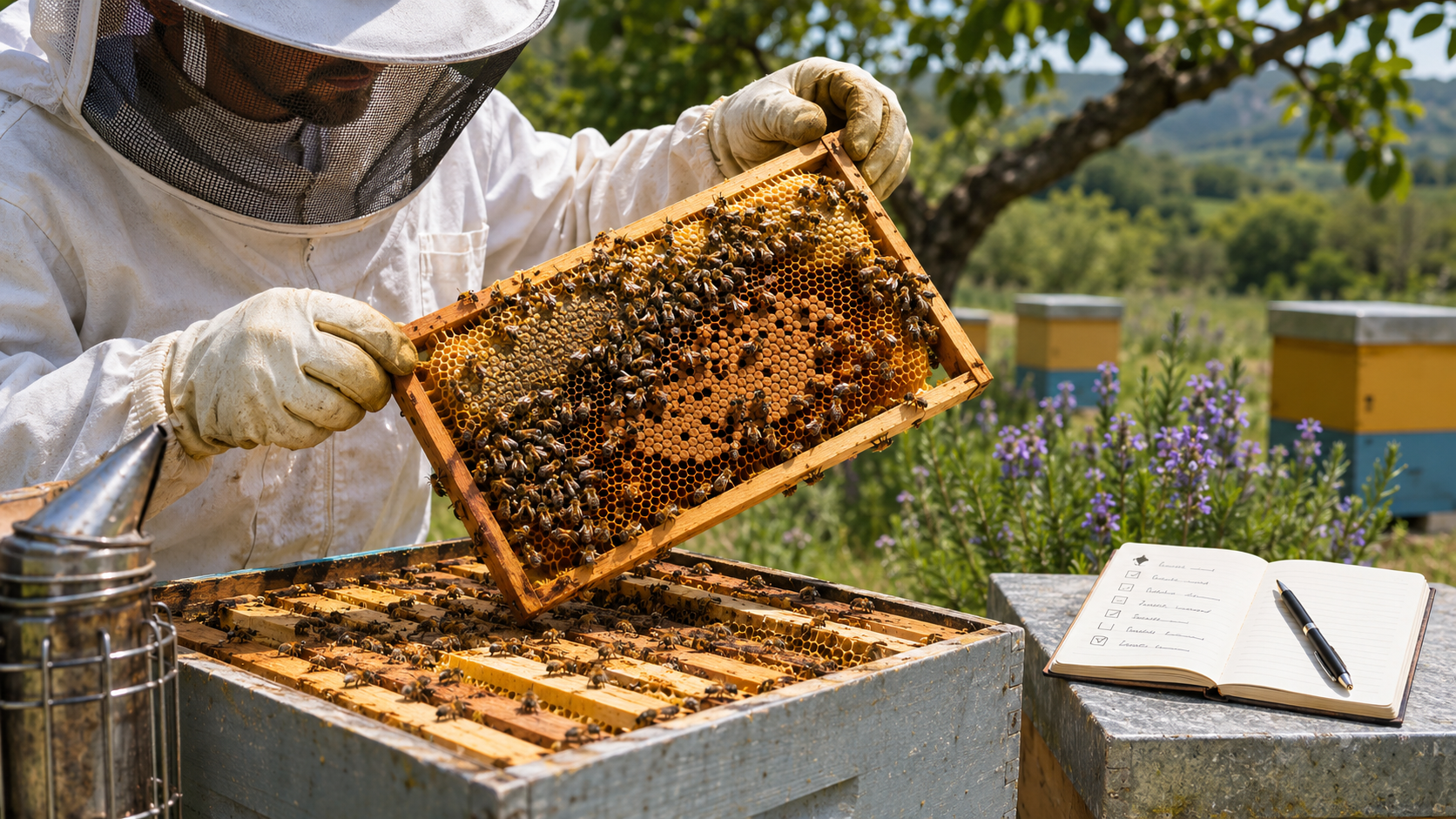
However, observing a hive is not just about checking for bees, brood, or food stores. An inspection gains real value when observations are recorded and can be compared with previous visits.
The goal is not only to know the current state of the colony but to understand its evolution over time.
1. Before Starting the Inspection
An inspection should have a defined purpose. Opening a hive without a clear objective can cause unnecessary disturbances to the colony.
Before the visit, consider:
- Weather conditions: temperature, wind, rain, and general conditions for bee activity.
- Time of year: the colony’s needs and development vary with the seasons.
- Hive history: previous observations, interventions performed, and situations requiring follow-up.
- Purpose of the visit: assessing brood pattern, checking stores, monitoring development, or confirming a prior observation.
The beekeeper should prepare personal protective equipment and necessary tools, verify their condition, and adopt proper hygiene measures—especially when working across different apiaries.
Not all inspections require fully opening the hive. In certain circumstances, external observation may provide enough information for the intended purpose.
2. What to Observe During the Inspection
2.1. Activity and Behavior
Observation begins before opening the hive.
Activity at the entrance, bee movement, pollen transport, and the presence of dead bees or abnormal behavior can provide clues about the colony’s condition.
During the inspection, it is also important to observe the bees’ reaction and any changes compared to previous visits.
Behavior should be interpreted in light of factors such as weather conditions, resource availability, and recent interventions.
A colony that is more defensive than usual does not necessarily indicate a health issue. Behavior can vary based on genetics, food availability, environmental conditions, or recent disturbances.
2.2. Queen and Egg-Laying
The presence of a functional queen is essential for colony continuity.
Direct observation of the queen is not always necessary. The presence of recent eggs and brood in different stages can indicate recent egg-laying activity.
Observe:
- Presence of eggs and young larvae.
- Distribution and continuity of brood.
- Presence of capped brood.
- Queen cells.
- Changes in egg-laying pattern compared to previous visits.
The absence of eggs in a single inspection does not, by itself, confirm the colony is queenless.
Egg-laying may decrease or temporarily stop due to the time of year, resource availability, or changes in colony dynamics.
The presence of queen cells should also be interpreted in context, as they may be associated with different processes, such as queen replacement, swarming, or rearing a new queen after the loss of the previous one.
2.3. Population and Development
Colony size is an important indicator of development.
It can be estimated by the number of frames or bars occupied by bees, considering the hive type used.
Records should allow:
- Tracking population changes.
- Identifying periods of growth or decline.
- Comparing colonies within the same apiary.
- Relating the adult population to the amount of brood present.
A reduced population does not necessarily indicate a problem. Interpretation depends on the time of year, colony history, and local conditions.
During winter, for example, it is natural for population and activity to differ from those observed in spring.
2.4. Food Stores
Honey and pollen stores are essential for the colony’s maintenance and development.
During the inspection, assess:
- Approximate quantity of stores.
- Food distribution within the hive.
- Presence of stored pollen.
- Relationship between stores, population, and brood quantity.
Food needs vary throughout the year and depend on factors such as nectar and pollen availability, weather conditions, and colony size.
The presence of stores does not, by itself, guarantee they are sufficient or accessible to bees under all conditions.
In cold periods, the location of stores relative to the cluster can influence their use.
2.5. Health Status
The inspection allows identifying signs that may warrant further observation.
Aspects to monitor include:
- Brood with abnormal appearance or distribution.
- Bees with visible changes.
- Unusual mortality.
- Presence of parasites or other organisms.
- Persistent behavioral changes.
- Signs of excessive moisture or hive condition issues.
Visual observation does not replace specific monitoring methods, laboratory analyses, or veterinary diagnosis.
Assessing Varroa destructor infestation, for example, requires appropriate monitoring methods. The mere absence of visible mites does not prove a low infestation.
Similarly, changes in brood may have different causes and should not be interpreted in isolation as confirmation of disease.
2.6. Physical Condition of the Hive
Beyond the colony, it is important to observe the condition of the equipment.
Relevant elements include:
- Structural and cover integrity.
- Presence of leaks or excessive moisture.
- Ventilation conditions.
- Condition of frames, bars, and combs.
- Signs of damage or other organisms.
- Hive stability and positioning.
Physical conditions can influence the internal environment and colony development.
3. What Should Be Recorded
Records should be simple enough not to hinder work in the apiary but detailed enough to allow future comparisons.
| Information | Example Record |
|---|---|
| Date | 11/07/2026 |
| Apiary and Hive | Apiary A — Hive 12 |
| Weather | 64 °F, light wind |
| Population | 7 frames occupied |
| Brood | Eggs, larvae, and capped brood |
| Queen | Not observed; eggs present |
| Stores | Moderate honey; pollen present |
| Behavior | Calm |
| Health | No visible changes |
| Interventions | None |
| Next Observation | Reassess stores |
Whenever possible, use consistent evaluation criteria across visits.
For example, repeatedly classifying stores as low, moderate, or high—based on criteria defined by the beekeeper—allows tracking trends, even without exact measurements.
It is equally important to distinguish between what was actually observed and the interpretation made.
“Queen not observed; eggs present” is a more precise record than “queen present” when the queen was not seen.
This distinction improves the quality of information and reduces the risk of incorrect conclusions.
4. Interpreting Colony Evolution
A single observation provides only a snapshot of a given moment.
The true value of records emerges when this information can be compared over time.
A reduction in population, for instance, may be related to seasonality, brood dynamics, resource availability, or other factors.
Comparing inspections helps identify changes and decide when further investigation is needed.
Comparing colonies within the same apiary can also yield useful insights, provided differences between them are considered.
Example of Monitoring
Consider a colony with the following records:
| Observation | Visit 1 | Visit 2 | Visit 3 |
|---|---|---|---|
| Population | 8 frames | 7 frames | 5 frames |
| Brood | Abundant | Moderate | Reduced |
| Stores | High | Moderate | Low |
| Behavior | Calm | Calm | Calm |
The simultaneous decrease in population, brood, and stores represents a trend that warrants attention.
However, these data alone do not determine the cause. Interpretation requires considering the time of year, environmental conditions, health history, and other relevant factors.
Recording does not mean diagnosing. It means preserving information to support decisions.
5. Inspection Frequency
There is no universal inspection frequency suitable for all colonies.
The schedule depends on several factors:
- Time of year.
- Colony development.
- Weather conditions.
- Resource availability.
- Beekeeper’s objectives.
- Specific situations requiring monitoring.
In spring, colony growth and the potential for swarming may justify more frequent observations.
During winter, weather conditions and the need to preserve the hive’s internal environment may call for a less intrusive approach.
An inspection should yield useful information while avoiding unnecessary interventions.
6. How abelhas.eu Can Help
abelhas.eu allows you to organize inspection records and associate them with specific hives and apiaries.
Over time, the beekeeper can review the history of observations and interventions, track apiary progress, and use available reports to identify trends.
Augusto, the platform’s digital assistant, can help review and interpret recorded data, highlighting aspects that may require attention.
The quality of analysis depends on the available information. Consistent, objective records over time provide a more complete picture of the operation.
The final management decision always rests with the beekeeper.
7. When to Seek Technical Support
Identifying abnormal mortality, persistent brood changes, signs consistent with disease, or uncertain health situations justifies contacting a beekeeping technician, veterinarian, or competent authority.
If notifiable diseases are suspected, official procedures must be followed.
Information gathered during inspections can be particularly useful in supporting this assessment.
Conclusion
An effective inspection does not depend solely on the amount of information observed but on the ability to recognize what is relevant and maintain consistent records.
Knowing the colony’s current state is important. Understanding how that state evolves is even more valuable.
Observe, record, compare, and decide: four actions that turn an inspection into a tool for monitoring the beekeeping operation.
Did You Know...?
The presence of recent eggs can indicate that egg-laying occurred in the last few days, even if the queen is not found during the inspection.
On the other hand, finding a queen does not, by itself, guarantee proper egg-laying. The assessment should also consider brood and the colony’s history.
References
- Directorate-General for Food and Veterinary Affairs (DGAV) — Animal Health and Beekeeping.
- World Organisation for Animal Health (WOAH) — Terrestrial Manual.
- COLOSS — Prevention of Honey Bee Colony Losses.
- Food and Agriculture Organization of the United Nations (FAO) — Beekeeping and Technical Resources.
This article is for informational purposes only and does not replace technical or veterinary assessment. Observations and procedures should be adapted to the operation’s conditions, time of year, and applicable regulations.
Related articles
- Monitoring Varroa Infestation
*Varroa destructor* is a parasitic mite of honey bees and represents one of the primary threats to *Apis mellifera* colony health.