Wiki article
Monitoring Varroa with CO₂: How It Works and What Science Says
Monitoring *Varroa destructor* infestation is one of the most critical activities in the health management of honey bee colonies.
By Equipa abelhas.eu
Article
Among the various available methods, the use of carbon dioxide (CO₂) has gained interest for enabling a quick assessment without requiring the deliberate sacrifice of bees used in the sample.
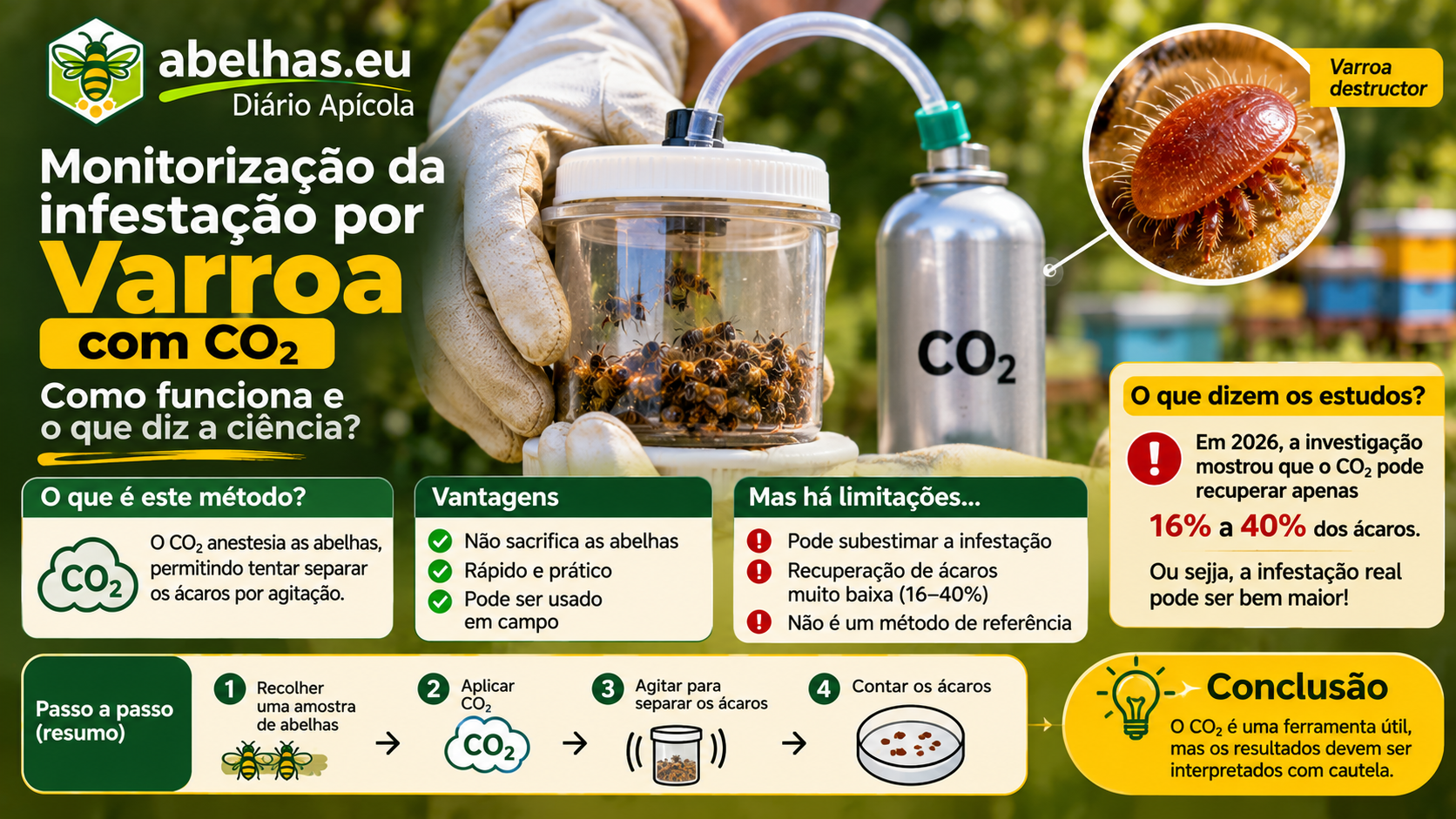
The principle is relatively simple: CO₂ induces temporary anesthesia in bees and mites, allowing an attempt to separate the parasites through controlled agitation.
However, ease of use does not necessarily mean the method produces sufficiently accurate results.
Scientific studies published in 2022 and 2026 identified significant limitations in CO₂’s ability to separate mites from bees, raising questions about its reliability for guiding health decisions.
1. How Does CO₂ Monitoring Work?
The method uses carbon dioxide to temporarily immobilize adult bees and the mites present on them.
During gas exposure, bees become anesthetized, and mites may lose their ability to remain attached to their hosts.
The sample is then agitated in an appropriate container, aiming to dislodge the mites and collect them on a surface where they can be counted.
The result is expressed as the number of mites per 100 adult bees sampled.
The goal is similar to other quantitative sampling methods, such as alcohol washes or powdered sugar.
The main difference lies in how mites are separated from the bees.
CO₂ does not eliminate *Varroa* from the colony. It is a sampling method, not a health treatment.
2. What Equipment Is Needed?
The application requires equipment designed for bee collection and controlled CO₂ administration.
One commercial example is the Varroa EasyCheck system, which allows the use of different monitoring procedures, including a configuration for CO₂ application.
The equipment may include:
- A transparent container for the bee sample.
- A perforated basket or compartment to separate mites.
- A gas introduction system.
- A compatible CO₂ cartridge or source.
- A surface for mite collection and counting.
The number of bees, exposure time, agitation method, and other parameters depend on the equipment and protocol used.
Improvising the use of pressurized containers or gas administration systems without proper control should be avoided.
CO₂ should be handled in a ventilated area, avoiding operator exposure to high concentrations.
3. How Is the Count Performed?
The following procedure describes the general principle of the method and does not replace manufacturer instructions.
Step 1 — Select the Sample
Adult bees are collected from a colony to be evaluated.
A sample of approximately 300 worker bees is frequently used in monitoring protocols.
It is important to avoid collecting the queen.
The sample’s origin should be consistent between assessments, as mite distribution is not necessarily uniform across the entire adult population.
Step 2 — Place the Bees in the Equipment
Bees are transferred to the sampling compartment, respecting the device’s capacity and instructions.
The number of bees should be known or estimated consistently.
Step 3 — Administer CO₂
The gas is introduced according to the equipment’s protocol, inducing temporary immobilization of the bees.
Excessive exposure may increase the risk of adverse effects.
It should not be assumed that longer anesthesia necessarily improves result quality.
Step 4 — Separate the Mites
After anesthesia, the container is moved according to the method’s instructions.
The goal is for the mites to detach from the bees and move to the collection area.
Step 5 — Count the Mites
Recovered mites are counted.
It is important to check surfaces and compartments where mites may have been retained.
Step 6 — Recover the Bees
Bees are removed from the equipment and, when in suitable condition, can be returned to the colony.
While the method aims to preserve bees, it is incorrect to guarantee that all recover without consequences.
CO₂ anesthesia can cause physiological and behavioral effects, and immediate survival does not necessarily indicate the absence of subsequent effects.
4. How Is the Result Calculated?
The formula is the same as that used in other quantitative sampling methods for adult bees.
Apparent infestation (%) = (Mites recovered / Bees sampled) × 100
For example, if 300 bees are collected and the equipment recovers 6 mites:
Apparent infestation = (6 / 300) × 100 = 2%
The result corresponds to two mites recovered per 100 bees in the sample.
However, there is a fundamental distinction.
With the CO₂ method, the number of mites recovered may be significantly lower than the number actually present on the bees.
Consequently, the calculated 2% may underestimate the true infestation.
The mathematical formula is correct, but the quality of the estimate depends on the method’s ability to recover mites.
5. What Did the 2022 Study Demonstrate?
In 2022, a scientific study was published comparing the use of CO₂ with the powdered sugar method.
Researchers used the Varroa EasyCheck device and evaluated samples of 300 bees.
After field procedures, they performed laboratory washes to identify mites that remained on the bees.
This second count allowed them to assess the recovery capacity of the initially used methods.
The results showed that powdered sugar performed better diagnostically than CO₂ application.
CO₂ failed to separate a sufficient proportion of mites present in the samples, leading to an underestimation of infestation.
Researchers concluded that the method was less reliable for quantifying Varroa in adult bees.
The study also highlighted the importance of improving the standardization of monitoring methods.
6. What Did the 2026 Study Reveal?
In August 2026, Frank D. Rinkevich, a researcher with the USDA Agricultural Research Service, published a new study in the Journal of Apicultural Research specifically focused on the use of CO₂ for Varroa monitoring.
The research evaluated two methods of gas administration:
- A CO₂ injector paired with the Varroa EasyCheck system.
- A CO₂ supply system from a laboratory cylinder.
The results were particularly relevant.
| Application Method | Average Mite Recovery Efficacy |
|---|---|
| CO₂ with EasyCheck injector | 16.0% |
| CO₂ with laboratory cylinder | 40.4% |
Recovery efficacy represents the proportion of mites effectively removed by the procedure relative to the mites present in the sample.
Thus, with the injector system, the average recovery was only 16 out of every 100 mites present.
Even the laboratory system, which performed better, recovered on average less than half of the mites.
Researchers also observed that performance was especially low in samples with low infestation levels.
Under these conditions, the injector’s efficacy could be less than 10%.
This limitation is particularly concerning because monitoring aims precisely to identify infestation before it reaches high levels.
Why Is This Important?
Imagine a sample of 300 bees with 12 mites.
The actual infestation in this sample would be:
12 / 300 × 100 = 4%
If a procedure recovered only 2 of those mites, the observed result would be:
2 / 300 × 100 = 0.67%
The beekeeper might interpret the result as a low infestation when the sample actually had a 4% infestation.
This example is illustrative and does not constitute a formula for correcting CO₂ results.
The method’s efficacy varies between samples and application conditions. Therefore, it is not possible to obtain a reliable estimate of actual infestation by simply applying a fixed multiplication factor.
7. Comparison with Other Monitoring Methods
Each method has advantages and limitations.
| Method | Deliberate Sample Sacrifice | Key Characteristic |
|---|---|---|
| Alcohol wash | Yes | Good mite recovery when performed correctly |
| Detergent wash | Yes | Quantitative reference alternative |
| Powdered sugar | No | Allows bees to be returned, but recovery may vary |
| CO₂ | No | Temporary anesthesia, but mite recovery may be very low |
| Natural drop | No | Tracks mites/day but does not directly measure adult bee infestation |
Alcohol or detergent washes remain an important reference for quantitatively assessing infestation in adult bees.
The powdered sugar method can be an alternative when avoiding deliberate sample sacrifice, though its accuracy depends on technique and usage conditions.
CO₂ offers the operational advantage of enabling quick counts and the recovery of many bees, but available scientific results do not support its use as an equivalent substitute for washing methods.
8. Is CO₂ Truly Harmless to Bees?
One of the main reasons for interest in this method is the ability to return bees to the colony.
However, it is important to distinguish three concepts:
Immediate survival: The bee regains movement after anesthesia.
Functional recovery: The bee resumes normal behavior and activities.
Absence of subsequent effects: Exposure does not cause relevant changes in physiology, longevity, or behavior.
The fact that a bee survives the procedure does not necessarily demonstrate that all three criteria have been met.
Exposure to CO₂ is known to induce physiological changes in insects, including honey bees.
The intensity and duration of these effects depend on the exposure conditions.
Thus, the method may avoid the deliberate mortality associated with alcohol washes, but it should not be presented as entirely risk-free.
9. When Does Using CO₂ Make Sense?
Despite the identified limitations, the technique may still be of interest in demonstration, research, or experimental comparison contexts.
For example, it can be used to study mite recovery under different conditions, provided the results are compared with a reference method.
For routine health decisions, however, the primary concern is the reliability of the estimate.
A method that recovers only a small proportion of mites may produce falsely reassuring results.
Therefore, a low count obtained using CO₂ should not be used as the sole evidence that infestation is under control.
When the result is used to guide a health decision, the situation should be confirmed using a more reliable quantitative method and appropriate technical guidelines.
Thresholds for intervention defined for other methods should not be directly applied to CO₂ results without specific validation.
10. What Information Should Be Recorded?
Traceability of the method used is essential for correctly interpreting results.
| Information | Recommended Record |
|---|---|
| Date | Monitoring date |
| Hive | Colony identification |
| Method | CO₂ |
| Equipment | Model or system used |
| Sample | Estimated number of bees |
| Recovered mites | Observed count |
| Apparent infestation | Mites per 100 bees |
| Conditions | Observations on procedure execution |
| Bee recovery | Observations after anesthesia |
| Confirmation method | Alcohol, detergent, or other, if used |
| Confirmed result | Value obtained by reference method |
| Observations | Other relevant factors |
The result should remain identified as an estimate obtained using CO₂, not as a measurement directly equivalent to an alcohol wash.
This distinction is important when analyzing historical data.
An apparent decrease in infestation may result from a change in method rather than an actual reduction in the mite population.
11. CO₂ Monitoring and Records on abelhas.eu
On abelhas.eu, health monitoring records allow tracking colony evolution and relating results to treatments, inspections, and other relevant events.
When different Varroa counting methods are used, it is important to identify the procedure associated with each measurement.
For CO₂, this identification is especially relevant due to the mite recovery limitations demonstrated in scientific studies.
The health history should distinguish results from alcohol washes, powdered sugar, natural drop, and CO₂, avoiding incorrect comparisons.
Augusto, the artificial intelligence assistant on abelhas.eu, can help interpret available records, considering the method used and observed trends.
A responsible analysis should not automatically interpret a low CO₂ count as a sign of low health risk.
The quality of decisions depends on the quality and context of the recorded data.
12. Conclusion
Monitoring Varroa with CO₂ presents an interesting proposition: estimating infestation without deliberately sacrificing sample bees.
The technique is relatively quick and uses specialized equipment to collect mites after anesthesia.
However, available scientific studies have identified significant limitations in parasite recovery.
Research published in 2026 found an average efficacy of only 16% with a commercial CO₂ injector and 40.4% with a laboratory system.
These results demonstrate that the method can significantly underestimate infestation, especially when Varroa levels are low.
The choice of a monitoring method should therefore balance the impact on bees, ease of use, and, above all, the reliability of results.
Preserving sample bees is an important goal. But a count that does not adequately detect *Varroa* can compromise the health of the entire colony.
References and Sources
- Rinkevich, F. D. (2026). Application of carbon dioxide for dislodging Varroa destructor for monitoring infestation yields inaccurate results. Journal of Apicultural Research. Published online August 29, 2026. https://doi.org/10.1080/00218839.2026.2711491
- Comparison of Two Diagnostic Techniques for the Apis mellifera Varroatosis: Strengths, Weaknesses and Impact on the Honeybee Health (2022). Scientific article available at: https://pmc.ncbi.nlm.nih.gov/articles/PMC9315579/
- Véto-pharma. Varroa Monitoring Guide. Information on monitoring methods, including CO₂ use: https://www.veto-pharma.com/wp-content/uploads/2022/07/varroa_guide_en_v2.pdf
- Virginia Tech Cooperative Extension (revised 2025). Varroa Mite Sampling Methods. https://ext.vt.edu/content/pubs_ext_vt_edu/en/ENTO/ENTO-332/ENTO-332.html
- COLOSS — BEEBOOK: Standard Methods for Apis mellifera Research. Standardized methods for Varroa research and monitoring.
Note: This article is for informational purposes. Monitoring results should be interpreted based on the method used, colony conditions, and applicable health guidelines.
Related articles
- Monitoring Varroa Infestation
*Varroa destructor* is a parasitic mite of honey bees and represents one of the primary threats to *Apis mellifera* colony health.