Wiki article
Holm Oak — *Quercus rotundifolia*
The holm oak (*Quercus rotundifolia* Lam.) is one of the most characteristic trees of Mediterranean ecosystems on the Iberian Peninsula. Highly drought-resistant and adapted to demanding environmental conditions, it plays a key role in soil conservation, biodiversity, and the structure of Portuguese agroforestry landscapes.
By Equipa abelhas.eu
Article
The holm oak (Quercus rotundifolia Lam.) is one of the most characteristic trees of Mediterranean ecosystems on the Iberian Peninsula. Drought-resistant and adapted to demanding environmental conditions, it plays a key role in soil conservation, biodiversity, and the structure of Portuguese agroforestry landscapes.
In beekeeping, its value is primarily associated with pollen production during spring, the potential availability of honeydew, and the diversity of plants that can coexist in holm oak montados.
Though commonly found in regions with a beekeeping tradition, the holm oak is not considered a significant nectar source.
Its value for bees should therefore be assessed within the context of the ecosystem where it is found.
1. Identification and Classification
| Characteristic | Description |
|---|---|
| Common name | Holm oak |
| Scientific name | Quercus rotundifolia Lam. |
| Family | Fagaceae |
| Genus | Quercus |
| Type | Evergreen tree |
| Foliage | Persistent |
| Pollination | Primarily wind-pollinated |
| Primary direct apicultural interest | Pollen |
| Other possible resources | Honeydew |
| Characteristic habitat | Montados, Mediterranean woodlands, and shrublands |
The taxonomic classification of the Iberian holm oak may vary between sources.
In some references, Quercus rotundifolia is recognized as a distinct species. In others, it is included under Quercus ilex, often as Quercus ilex subsp. ballota.
This difference stems from taxonomic interpretations and does not necessarily mean completely different trees are being described.
For identification purposes in Portuguese flora, it is important to consider the synonyms used in different botanical databases.
2. How to Identify a Holm Oak?
<AsyncImageGroup query={["Quercus rotundifolia holm oak tree Portugal montado landscape","Quercus rotundifolia leaves underside acorns close up botanical","Quercus rotundifolia male catkins flowering spring"]} aspectRatio="5:4" layout="carousel"/>
Trunk and Bark
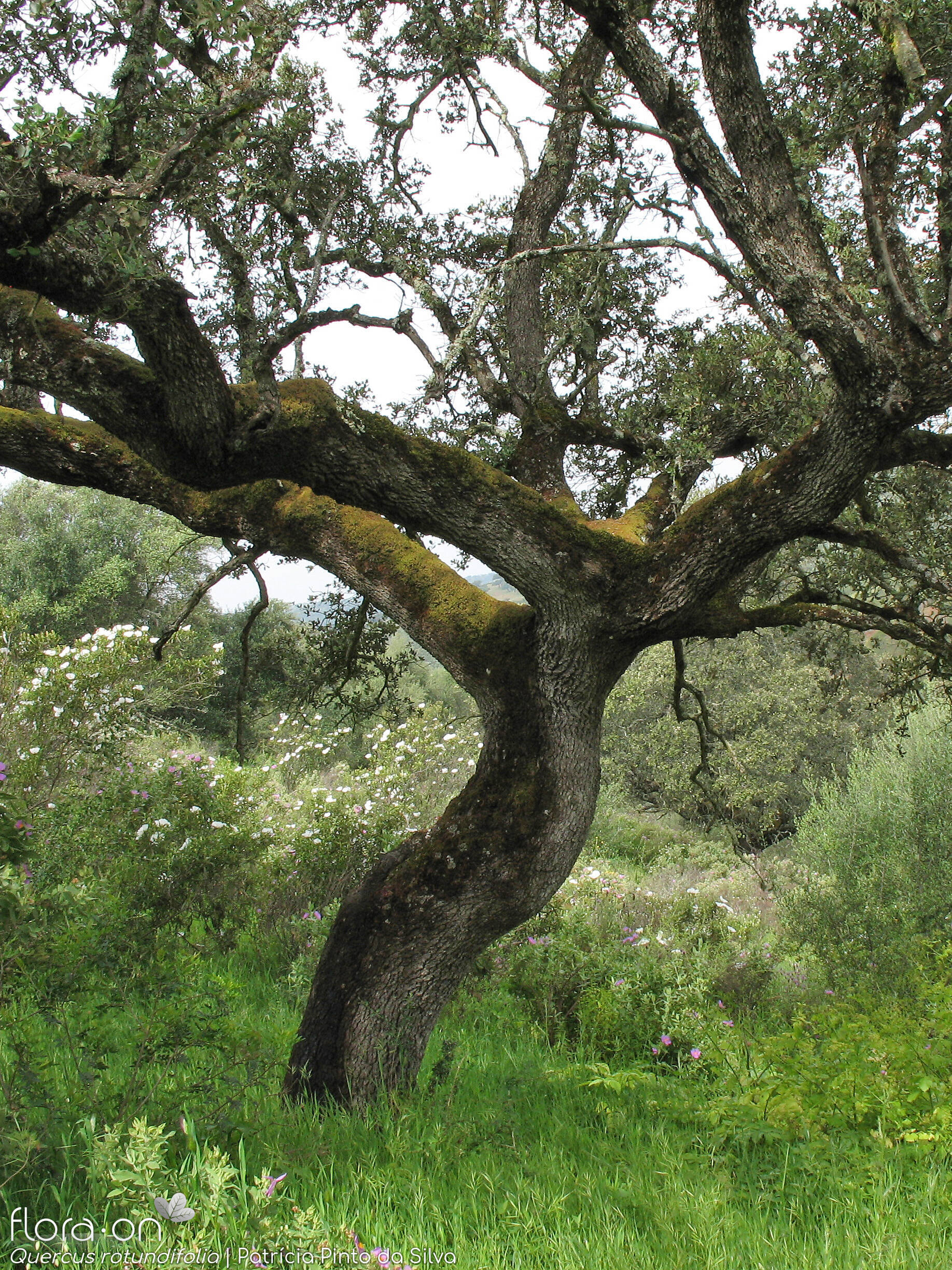
The holm oak generally has a robust trunk with gray to dark bark that becomes increasingly fissured with age.
The crown is often broad, rounded, and dense, though its shape varies depending on growing conditions and tree management.
In drier environments or areas subject to grazing, it may be smaller than in more favorable locations.
Leaves
The leaves are evergreen, leathery, and relatively small.
The upper surface is typically dark green, while the underside is lighter, often grayish or whitish due to the presence of hairs.
The margins may be smooth or toothed, especially in young plants or shoots.
This variability can make identification difficult when observing only isolated leaves.
Flowers
The holm oak has both male and female flowers on the same tree.
Male flowers are grouped in pendulous catkins, which may take on yellowish hues during pollen release.
Female flowers are small and inconspicuous.
Fruits
The fruit is an acorn, partially enclosed by a cupule.
Holm oak acorns are an important food resource for various animals, including wildlife and livestock in traditional montado systems.
The shape, size, and flavor of acorns can vary between individual trees.
3. Distribution in Portugal
The holm oak is primarily found in regions with a Mediterranean influence, particularly in the interior and southern parts of mainland Portugal.
It is common in areas of the Alentejo, the central interior, and other regions with hot, dry summers.
Holm oak montados are agroforestry systems where trees coexist with pastures, shrubs, and other plant species.
The distribution of the holm oak is influenced by factors such as:
- Temperature and precipitation.
- Soil water availability.
- Terrain depth and characteristics.
- Sun exposure.
- Historical agricultural and forestry use.
- Grazing pressure.
The species exhibits high drought tolerance and can thrive in various soil types, including calcareous substrates.
This adaptability contributes to its presence in regions where other tree species may face greater limitations.
However, drought resistance does not mean it is invulnerable to prolonged periods of water stress.
4. Holm Oak Flowering
Flowering typically occurs during spring.
In Portugal, the most common period is between April and May, though it may start earlier in warmer regions or extend into cooler areas.
| Condition | Indicative Period |
|---|---|
| Warmer regions | March to April |
| Most of the territory | April to May |
| Cooler or elevated regions | May to June |
The periods shown are approximate.
Flowering depends on temperatures, water availability, sun exposure, and annual weather conditions.
How Does Pollination Occur?
The holm oak is primarily an anemophilous species.
This means pollen is transported between flowers mainly by wind.
The flowers do not rely on insect attraction to ensure pollination.
However, bees may visit male catkins and collect pollen.
A wind-pollinated species can, therefore, contribute to bee nutrition even if it does not depend on them for reproduction.
5. Apiary Interest
The holm oak’s value for beekeeping can be divided into three components: pollen, honeydew, and the ecological contribution of the montado.
5.1. Pollen
During flowering, male catkins release significant amounts of pollen.
Bees may collect this resource when environmental conditions and the availability of other sources make it attractive.
Pollen is essential for colony development, providing proteins, lipids, and other nutrients needed for larval feeding and bee physiological function.
However, the holm oak’s actual contribution depends on several factors:
- Flowering intensity.
- Number of flowering trees.
- Weather conditions during pollen release.
- Presence of other pollen-producing species.
- Colony nutritional needs.
- Bee foraging activity.
The presence of abundant pollen in the environment does not necessarily mean bees will use it as a primary resource.
5.2. Nectar
The holm oak is not typically considered a significant nectar source.
Its flowers are primarily adapted for wind pollination.
For this reason, the presence of holm oaks should not be used as a direct indicator of abundant nectar flow.
5.3. Honeydew
The holm oak may be associated with honeydew production under certain conditions.
Honeydew is a sugary substance that can result from the activity of sap-sucking insects present on the trees.
Bees may collect these substances and use them in honey production.
Honeydew availability depends on the presence of producing organisms, their activity, and environmental conditions.
It is not, therefore, a constant or guaranteed resource.
Honeydew production can vary significantly between years and even between nearby locations.
5.4. The Holm Oak Montado
The montado is an ecosystem where numerous plant species with different flowering periods can coexist.
Plants that may occur in these environments include:
- Rockroses and other Cistaceae.
- Lavenders and other aromatic plants.
- Heaths, depending on soil conditions.
- Clovers and other herbaceous legumes.
- Various spontaneous spring-flowering plants.
The composition depends on local conditions and land management.
An apiary’s value in a montado may stem primarily from this diversity, not just the presence of holm oaks.
A montado with diverse herbaceous and shrub vegetation can provide resources over longer periods than an area with minimal understory.
6. Differences Between Holm Oak and Cork Oak
The holm oak and cork oak belong to the same botanical genus but have distinct characteristics.
| Characteristic | Holm Oak | Cork Oak |
|---|---|---|
| Scientific name | Quercus rotundifolia | Quercus suber |
| Bark | Dark and fissured | Thick, cork-producing |
| Leaves | Often small and rigid | Generally larger and less rigid |
| Drought resistance | Very high | High |
| Soils | Includes calcareous soils | Generally prefers non-calcareous soils |
| Pollination | Wind | Wind |
| Floral resource for bees | Pollen | Pollen |
| Honeydew | Possible | Possible |
The two species may coexist in certain regions, forming mixed montados.
Identification should consider the tree’s overall characteristics, particularly bark, leaves, and fruits.
7. Importance Throughout the Year
Spring
Flowering can provide pollen during a phase of colony growth.
The simultaneous presence of other flowering species can increase available food diversity.
Summer
The holm oak retains its foliage and exhibits high drought resistance.
Though not a regular nectar source, it may contribute to habitat structure and, under certain conditions, be associated with honeydew availability.
The shade provided by its crowns can also influence the local microclimate.
Fall
Acorn maturation is an important event for montado wildlife but does not represent a direct food resource for bees.
Food availability for colonies will depend primarily on other plant species and environmental conditions.
Winter
Direct food value is generally low.
The holm oak’s importance is mainly tied to maintaining the montado’s ecological structure.
8. Holm Oak and Honey Production
The presence of holm oaks in a foraging area does not mean the honey produced is predominantly from this species.
Honey production may result from the nectar of other plants in the montado or, under certain conditions, from the collection of honeydew.
Honeydew Honey
Honeydew honey has different characteristics from honeys produced primarily from nectar.
It may exhibit darker hues, a distinct mineral composition, and other unique physicochemical properties.
However, these characteristics vary depending on the source of the honeydew and the honey’s composition.
Identifying the botanical or geographic origin requires proper analysis.
The presence of holm oaks around an apiary is not sufficient to classify honey as originating from this species.
Importance of Other Flowering Plants
In montados, honey production may depend significantly on herbaceous and shrub species that bloom before, during, or after holm oak flowering.
Plant diversity can contribute to a more extended supply of resources.
Therefore, assessing an apiary’s productive potential should consider the surrounding landscape, not just the dominant tree species.
9. Factors Influencing Apiary Potential
Weather Conditions
Temperature, precipitation, and wind influence flowering and bee foraging activity.
Heavy rain or strong winds during pollen release can reduce its availability for collection.
Flowering Intensity
The number of flowers can vary between trees and from year to year.
Understory Diversity
The presence of herbaceous and shrub plants can be crucial for nectar and pollen availability.
Land Management
Grazing intensity, soil disturbance, and vegetation control can alter plant community composition.
Tree Health
Diseases, pests, and water stress can compromise holm oak development.
Colony Proximity
The distance between resources and apiaries influences foraging effort.
The presence of a species within a several-kilometer radius does not guarantee its use by bees.
10. What to Observe in the Apiary?
When holm oaks are present in the foraging area, beekeepers can monitor several key indicators:
- Start and duration of flowering.
- Intensity of catkin production.
- Presence of bees collecting pollen.
- Pollen entering the hives.
- Evolution of protein reserves.
- Simultaneous flowering of other species.
- Changes in hive weight.
- Possible signs of honeydew availability.
Direct observation can confirm the use of specific resources.
However, the presence of pollen in hives does not allow for reliable botanical identification based solely on color.
Different species may produce pollen with similar hues.
When precise identification is needed, appropriate laboratory techniques can be used.
11. Holm Oak and Apiary Management on abelhas.eu
Understanding the surrounding flora helps contextualize colony development and natural resource availability.
On abelhas.eu, information about plant species can be linked to apiary locations and records of inspections, food reserves, and production.
Observing flowering patterns over several years can help identify local trends and periods of greater or lesser food availability.
Meteorological data can complement these observations, providing a better understanding of how environmental conditions influence resource availability.
Augusto, the AI assistant from abelhas.eu, can help interpret recorded data and identify relevant relationships for hive management.
It is important to distinguish between the potential presence of a species in a region and the actual availability of resources for bees.
The existence of holm oaks in a given area does not, by itself, indicate that they are providing pollen or honeydew at a specific time.
The goal is to transform observations and records into useful information to support decision-making.
12. Conservation and Ecological Importance
The holm oak holds significant environmental and cultural value in Portugal.
Holm oak montados contribute to:
- Biodiversity conservation.
- Soil erosion protection.
- Carbon sequestration.
- Habitat maintenance.
- Sustainability of agroforestry systems.
- Preservation of traditional Mediterranean landscapes.
The species is subject to specific legal protection in Portugal, similar to the cork oak.
Cutting, uprooting, and certain interventions on holm oaks may require authorization under applicable legislation.
Conserving trees and associated plant diversity supports ecosystem stability and the maintenance of resources used by various pollinators.
13. Conclusion
The holm oak is a fundamental species in Portuguese Mediterranean ecosystems.
Its direct apicultural value is primarily associated with pollen availability during flowering and the potential presence of honeydew.
However, it should not be considered a relevant nectar source.
Its greatest contribution to beekeeping may stem from the plant diversity and ecological conditions provided by holm oak montados.
Observing flowering patterns, monitoring food reserves, and tracking colony development help better understand the importance of these environments for each operation.
Understanding the holm oak means grasping a key part of the Mediterranean landscape and the resources that can sustain colonies throughout the year.
References and Sources
- Flora-On — Interactive Flora of Portugal. Quercus rotundifolia Lam. and its taxonomic synonyms. https://flora-on.pt
- Plants of the World Online — Royal Botanic Gardens, Kew. Taxonomic information on Quercus rotundifolia and Quercus ilex. https://powo.science.kew.org
- Instituto da Conservação da Natureza e das Florestas (ICNF) — Information on holm oak, cork oak, and montados. https://www.icnf.pt
- European Forest Genetic Resources Programme (EUFORGEN) — Information on forest genetic resources and Mediterranean Quercus species. https://www.euforgen.org
- FAO — Publications on Mediterranean agroforestry systems and forest resource conservation. https://www.fao.org
- Direção-Geral de Alimentação e Veterinária (DGAV) — Information on beekeeping production and food safety. https://www.dgav.pt
Note: Flowering periods and apicultural resource availability are indicative and may vary significantly by region and annual weather conditions.
Related articles
- Cork Oak — *Quercus suber*
The cork oak (*Quercus suber* L.) is one of the most emblematic trees in the Portuguese landscape. Primarily known for its cork production, it also plays a significant role in Mediterranean ecosystems, contributing to biodiversity, soil protection, and the maintenance of habitats favorable to numerous insect species.
- Assessing Colony Food Reserves
Food availability is one of the fundamental factors for the development and survival of a honey bee colony.