Wiki article
Cork Oak — *Quercus suber*
The cork oak (*Quercus suber* L.) is one of the most emblematic trees in the Portuguese landscape. Primarily known for its cork production, it also plays a significant role in Mediterranean ecosystems, contributing to biodiversity, soil protection, and the maintenance of habitats favorable to numerous insect species.
By Equipa abelhas.eu
Article
In beekeeping, its value is primarily associated with pollen production, the potential availability of honeydew under certain conditions, and the diversity of floral resources found in cork oak montados.
Though not typically considered a major nectar-producing species, its presence can contribute to the ecological quality of bee foraging areas.
1. Identification and Classification
| Characteristic | Description |
|---|---|
| Common Name | Cork Oak |
| Scientific Name | Quercus suber L. |
| Family | Fagaceae |
| Genus | Quercus |
| Type | Evergreen tree |
| Foliage | Persistent |
| Pollination | Predominantly wind-pollinated |
| Primary Direct Beekeeping Value | Pollen |
| Other Potential Resources | Honeydew |
| Characteristic Habitat | Montados and Mediterranean forests |
The cork oak is a relatively slow-growing, long-lived tree that can reach considerable size under favorable conditions.
Its most well-known feature is its thick, corky bark, from which cork is extracted.
This bark is an important adaptation to Mediterranean environments, providing protection against high temperatures and certain effects of wildfires.
2. How to Identify a Cork Oak?
<AsyncImageGroup query={["Quercus suber cork oak tree Portugal montado landscape","Quercus suber cork oak leaves acorns close up","Quercus suber cork bark trunk close up"]} aspectRatio="5:4" layout="carousel"/>
Trunk and Bark
The bark is thick, irregular, and deeply fissured, forming the characteristic cork of the species.
After cork extraction, the trunk often displays a reddish surface that gradually darkens.
Leaves
The leaves are evergreen, relatively small and leathery, with a shape varying between oval and elongated.
The upper surface is generally dark green, while the underside is lighter and may have a fine hairy covering.
The margins may be smooth or have small teeth.
Flowers
The cork oak produces separate male and female flowers on the same tree.
Male flowers are grouped in pendulous catkins, often yellowish during pollen release.
Female flowers are small and inconspicuous.
Fruit
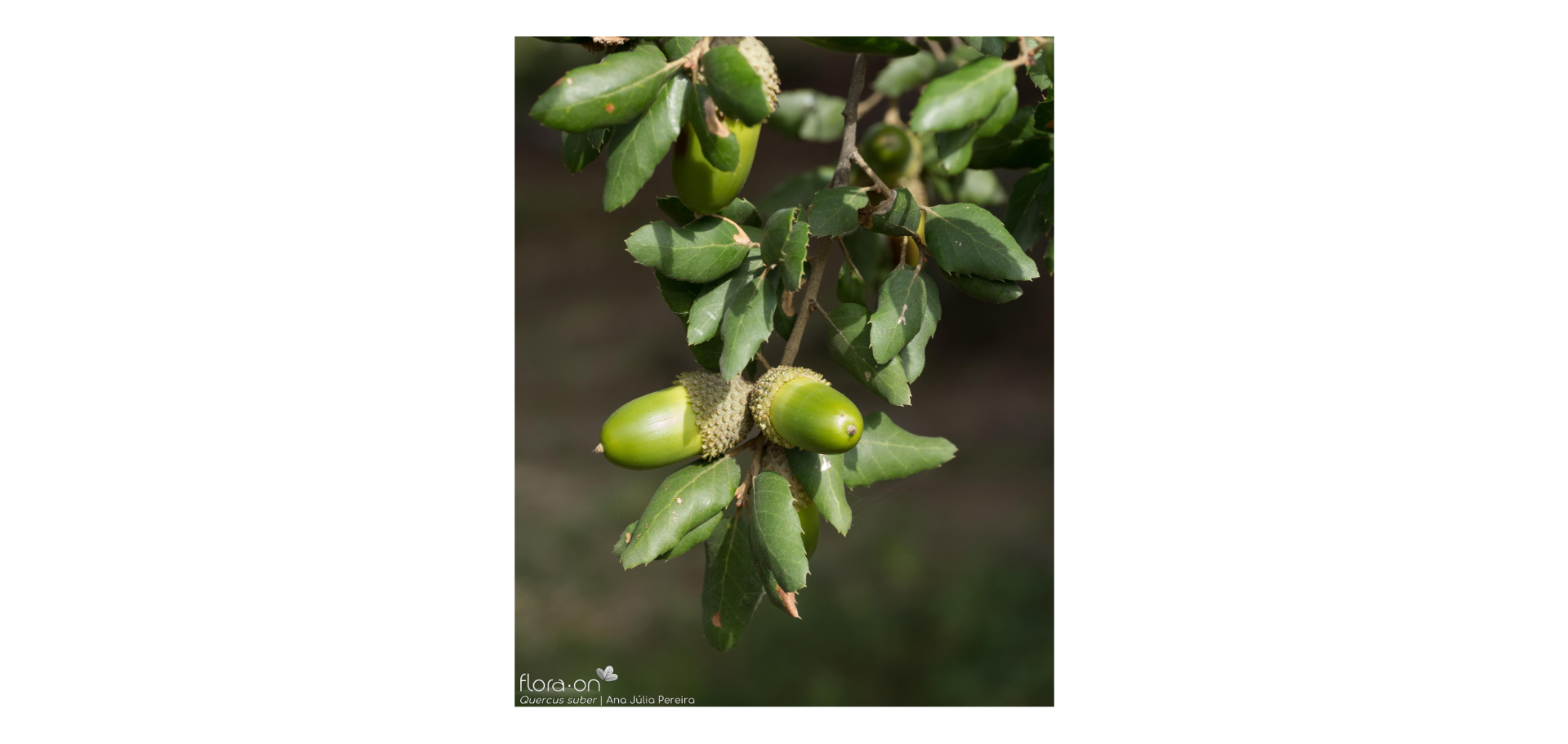
The fruits are acorns, partially enclosed by a cupule.
They serve as an important food resource for various wildlife species, contributing to the ecological value of montados.
3. Distribution in Portugal
The cork oak is widely distributed in mainland Portugal, particularly in Mediterranean-influenced regions.
It is especially representative of the Alentejo and Ribatejo, though it also occurs in other parts of the country.
Cork oak montados are characteristic agroforestry systems where cork oaks coexist with pastures, shrubs, agricultural crops, and other tree species.
Distribution and density vary based on factors such as:
- Soil type and depth.
- Water availability.
- Temperature and sun exposure.
- Land-use history.
- Forestry and agricultural management.
The cork oak generally prefers well-drained, often acidic or siliceous soils, showing less adaptation to highly calcareous soils.
Its presence in a given region does not mean all areas offer equally favorable conditions for beekeeping resources.
4. Cork Oak Flowering
Flowering generally occurs during spring.
In Portugal, it typically takes place between April and May, though regional and annual variations exist.
Floral development depends on weather conditions, temperature, and the tree’s physiological state.
| Region or Condition | Indicative Period |
|---|---|
| Warmer regions | March to May |
| Most of the territory | April to May |
| Cooler or elevated areas | April to June |
These periods are indicative and do not constitute a fixed calendar.
Local observation remains the most reliable way to confirm the onset and intensity of flowering.
How Does Pollination Occur?
The cork oak is a predominantly anemophilous species, meaning pollination is carried out by wind.
Its flowers do not exhibit the typical characteristics of species specialized in attracting insect pollinators.
However, bees may visit male catkins to collect pollen.
This distinction is important: a plant may be primarily wind-pollinated and still provide pollen utilized by bees.
5. Beekeeping Value
The beekeeping value of the cork oak should be analyzed in three dimensions: pollen, honeydew, and ecosystem contribution.
5.1. Pollen Production
Pollen is the primary direct floral resource that the cork oak can provide to bees.
During flowering, male catkins release considerable amounts of pollen.
Bees may collect it when weather conditions permit flight and when this resource is competitive compared to other available sources.
Pollen provides proteins, lipids, vitamins, and other nutrients necessary for colony development.
However, the amount of pollen produced by a tree does not necessarily correspond to the amount effectively collected by bees.
Utilization depends on accessibility, bee preference, and the simultaneous availability of other species.
5.2. Nectar Production
The cork oak is not generally considered a relevant nectar source.
Its flowers are primarily adapted for wind pollination rather than attracting pollinators through nectar rewards.
Therefore, it should not be classified as a high-potential nectar-producing species solely due to its abundance in a given region.
5.3. Honeydew
Under certain conditions, cork oaks and other Quercus species may be associated with the availability of honeydew.
Honeydew is a sugary substance produced mainly from the excretions of insects that feed on plant sap.
Bees may collect this substance and use it in honey production.
Unlike nectar, honeydew is not a floral secretion.
Its availability depends on the presence and activity of producing organisms, environmental conditions, and other ecological factors.
Thus, the presence of cork oaks does not guarantee regular honeydew production.
5.4. Importance of the Montado
The beekeeping value of a montado area can be significantly greater than the direct contribution of cork oaks.
These ecosystems may include numerous herbaceous, shrub, and tree species that provide nectar and pollen at different times.
Species commonly found in montado landscapes include rockroses, lavenders, heathers, strawberry trees, and various herbaceous plants.
The specific composition varies by region, soil type, and management practices.
A montado with high plant diversity can provide a succession of useful flowerings for colony nutrition.
Conversely, a montado with a sparse understory may offer fewer floral resources, even with a high density of cork oaks.
6. Importance for Colonies Throughout the Year
The cork oak’s contribution varies by season and the dynamics of surrounding vegetation.
Spring
During flowering, it may provide pollen.
At this stage, many colonies are in development, with increasing population and brood rearing.
The availability of protein resources can help sustain this expansion.
Summer
The cork oak retains its foliage but does not necessarily serve as a direct food source for bees.
Potential honeydew availability depends on ecological conditions.
However, the montado can create shade and influence the local microclimate.
Fall
The presence of other plant species in the montado may contribute to resource availability, depending on rainfall and vegetation development.
The cork oak alone should not be considered a guarantee of fall nutrition.
Winter
During winter, the cork oak’s direct value as a food source is generally low.
Its contribution is primarily associated with the structure and stability of the ecosystem.
7. Cork Oak and Honey Production
The presence of cork oaks in a foraging area does not imply that the honey produced originates predominantly from this species.
It is important to distinguish:
Nectar honey: Produced from nectar collected from flowers.
Honeydew honey: Produced mainly from secretions of living plant parts or excretions of sap-feeding insects.
The cork oak’s potential contribution to honey production may occur through honeydew associated with the tree.
However, identifying the botanical origin of honey requires proper evaluation and should not be based solely on the surrounding vegetation.
Honey composition results from the resources effectively collected by bees.
8. Factors Influencing Beekeeping Value
The potential of an area with cork oaks depends on several factors.
Tree Density and Condition
Healthy, well-developed trees may exhibit greater flowering capacity, though individual and annual variations exist.
Plant Diversity
The presence of different species in the understory increases the availability of resources throughout the year.
Montado Management
Grazing, soil tillage, vegetation control, and other management practices can alter floral composition.
Weather Conditions
Rain, temperature, wind, and humidity influence flowering, pollen release, and bee activity.
Water Availability
Water is essential for colony function and may influence the suitability of a location for apiary placement.
Environmental Pressures
Prolonged drought, wildfires, pests, and forest diseases can compromise tree health and ecosystem stability.
9. What to Observe in the Apiary?
When cork oaks are present in the foraging area, beekeepers can monitor their contribution through regular observations.
Some relevant aspects include:
- Onset and duration of flowering.
- Intensity of pollen release.
- Presence of bees on catkins.
- Pollen intake in hives.
- Evolution of protein reserves.
- Changes in hive weight.
- Presence of potential honeydew sources.
- Simultaneous flowering of other species.
Observing bees collecting pollen from a cork oak confirms the use of that resource at that moment but does not, by itself, quantify its importance for the colony’s overall nutrition.
Similarly, an increase in hive weight does not automatically demonstrate honeydew intake from cork oaks.
Interpretation should consider other available resources.
10. Recording Beekeeping Flora on abelhas.eu
Understanding the flora around apiaries helps assess resource availability throughout the year.
On abelhas.eu, information about plant species can be linked to apiary locations, field observations, and colony development records.
Tracking flowerings allows the creation of a local history, identifying periods of higher or lower resource availability.
When combined with weather data, food reserves, production, and population trends, this history can support management decisions.
Augusto, abelhas.eu’s AI assistant, can help interpret available information, assisting beekeepers in connecting observations and identifying patterns.
However, the presence of a plant species should not be automatically interpreted as effective nectar or pollen availability.
The goal is to support decisions through contextualized information, respecting the natural variability of ecosystems.
11. Conservation and Ecological Importance
The cork oak is a species of high environmental, economic, and cultural value in Portugal.
Cork oak montados contribute to:
- Biodiversity conservation.
- Soil protection.
- Carbon sequestration.
- Habitat maintenance for various species.
- Sustainability of Mediterranean agroforestry systems.
Cork harvesting yields a renewable product without the need to fell the tree.
In Portugal, the cork oak is subject to a specific legal protection regime.
Cutting, uprooting, and certain interventions on these trees may require authorization and compliance with applicable legislation.
The conservation of cork oaks and associated ecosystems benefits not only cork production but also biological diversity and resources available to pollinators.
12. Conclusion
The cork oak is a fundamental species in the Portuguese Mediterranean landscape and ecosystems.
Its direct beekeeping value is primarily associated with pollen availability during flowering and the potential presence of honeydew under certain conditions.
However, it should not be classified as an important nectar source.
The greatest contribution to beekeeping may come from the plant diversity and ecological stability of the montados where it grows.
Understanding the cork oak means comprehending not just a tree, but an entire ecosystem that can influence resource availability and colony development.
References and Consulted Sources
- Flora-On — Interactive Flora of Portugal. Quercus suber L. https://flora-on.pt
- Institute for Nature Conservation and Forests (ICNF) — Information on cork oak, holm oak, and montado. https://www.icnf.pt
- European Forest Genetic Resources Programme (EUFORGEN) — Quercus suber. https://www.euforgen.org
- Portuguese Botanical Society — Information on Portuguese flora.
- FAO — Publications on Mediterranean agroforestry systems and forest resources.
- Directorate-General for Food and Veterinary Affairs (DGAV) — Information on beekeeping production and food safety. https://www.dgav.pt
Note: Flowering periods and beekeeping resource availability are indicative and may vary significantly by region and annual conditions.
Related articles
- Holm Oak — *Quercus rotundifolia*
The holm oak (*Quercus rotundifolia* Lam.) is one of the most characteristic trees of Mediterranean ecosystems on the Iberian Peninsula. Highly drought-resistant and adapted to demanding environmental conditions, it plays a key role in soil conservation, biodiversity, and the structure of Portuguese agroforestry landscapes.
- Assessing Colony Food Reserves
Food availability is one of the fundamental factors for the development and survival of a honey bee colony.